Chainbreaker
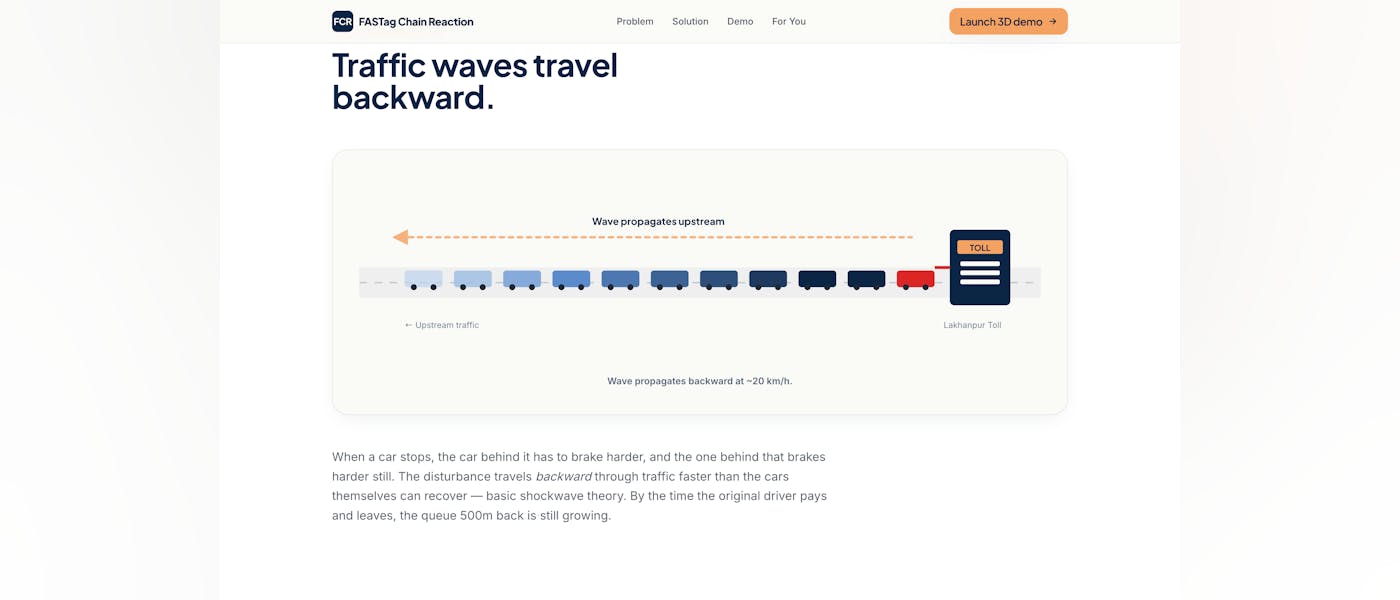
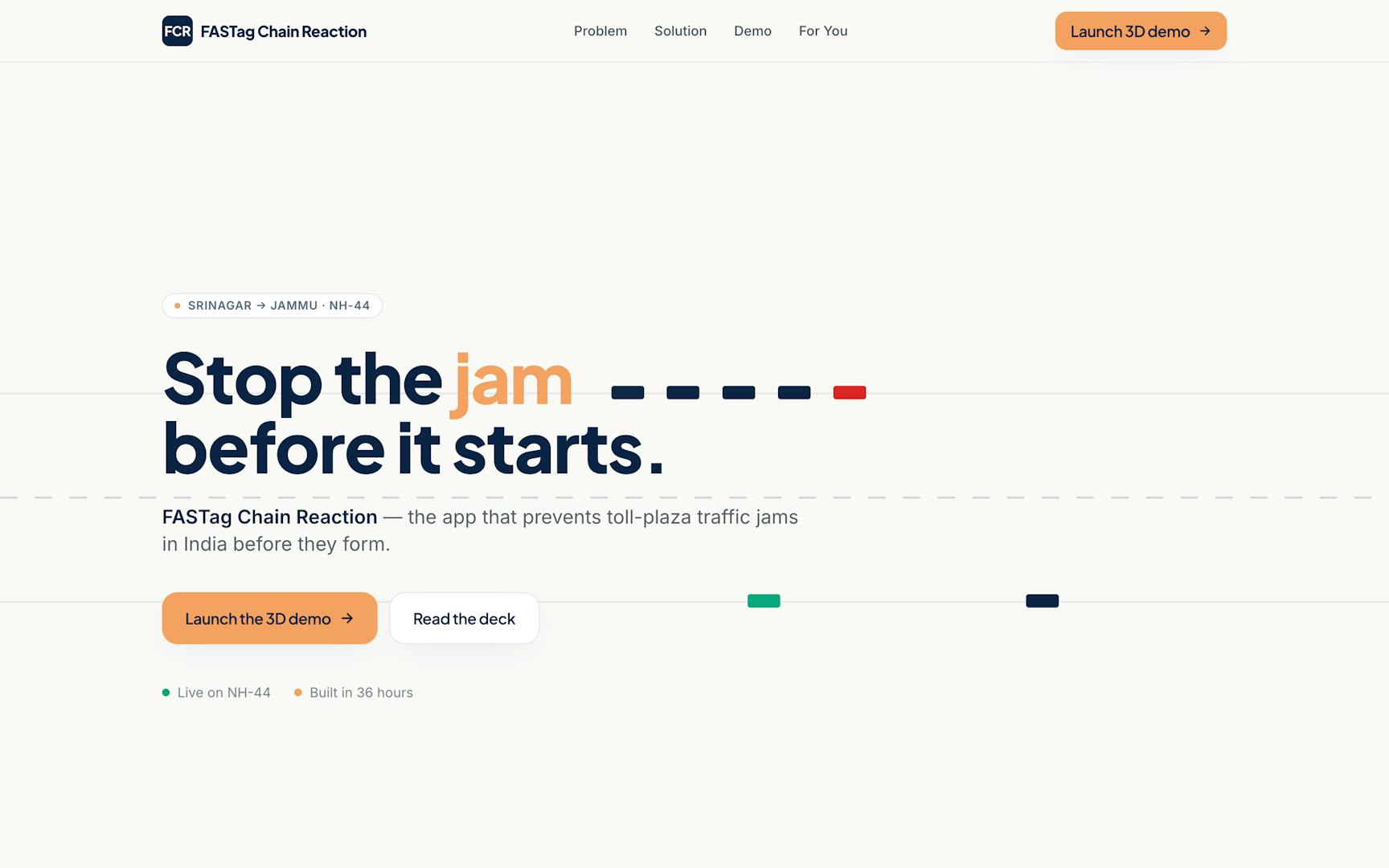
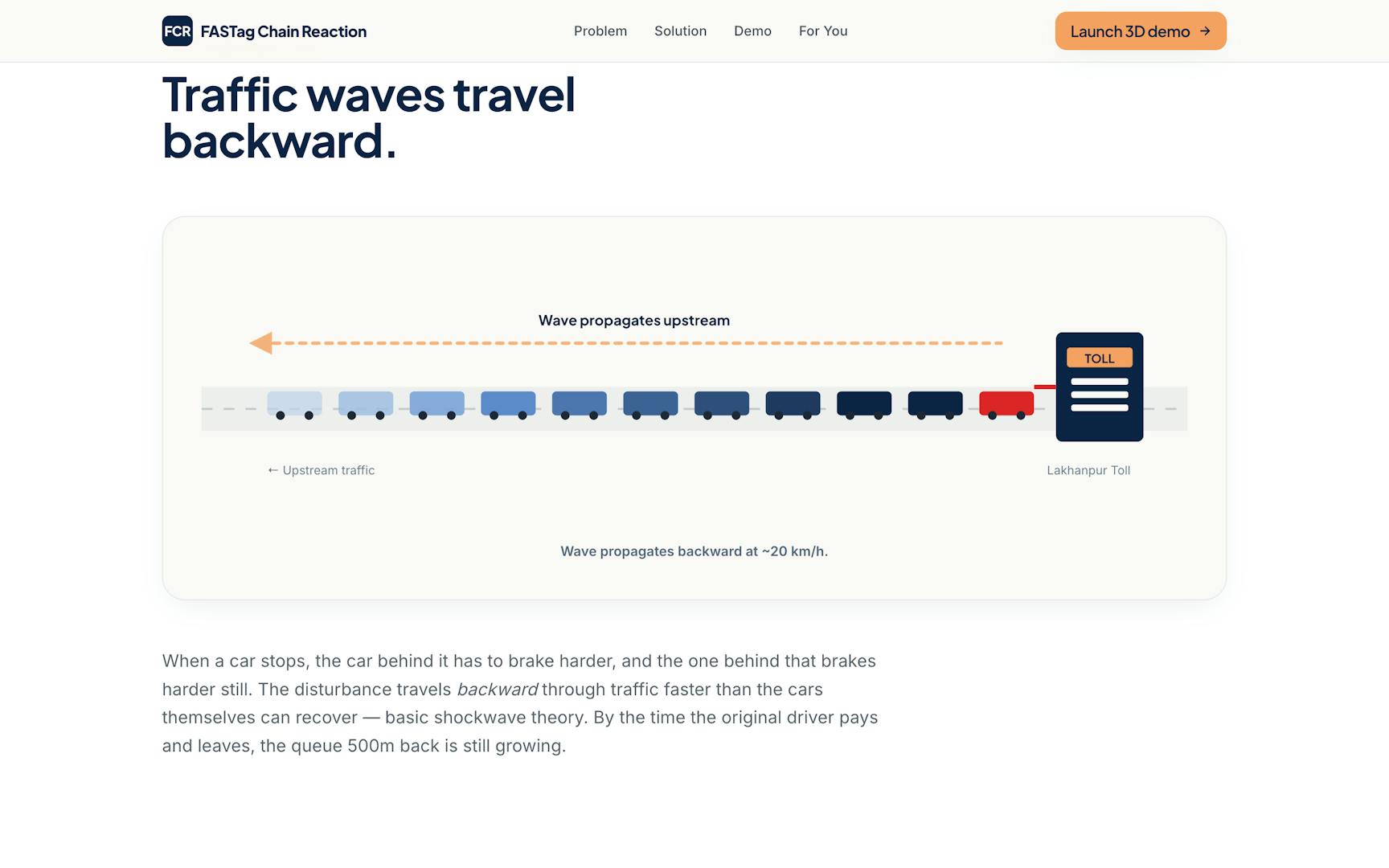
One driver with a low FASTag balance stalls an Indian toll booth for ~90 seconds that single stall backs up 25–71
vehicles, propagates upstream at 20 km/h, and delays ambulances 4–6 minutes. ChainBreak fixes it at the source: a 5 km
geofence warning tells you your FASTag balance is too low before you reach the booth, and a one-tap UPI recharge
settles it in under 8 seconds. You cross the boom at full speed. The chain reaction never starts.
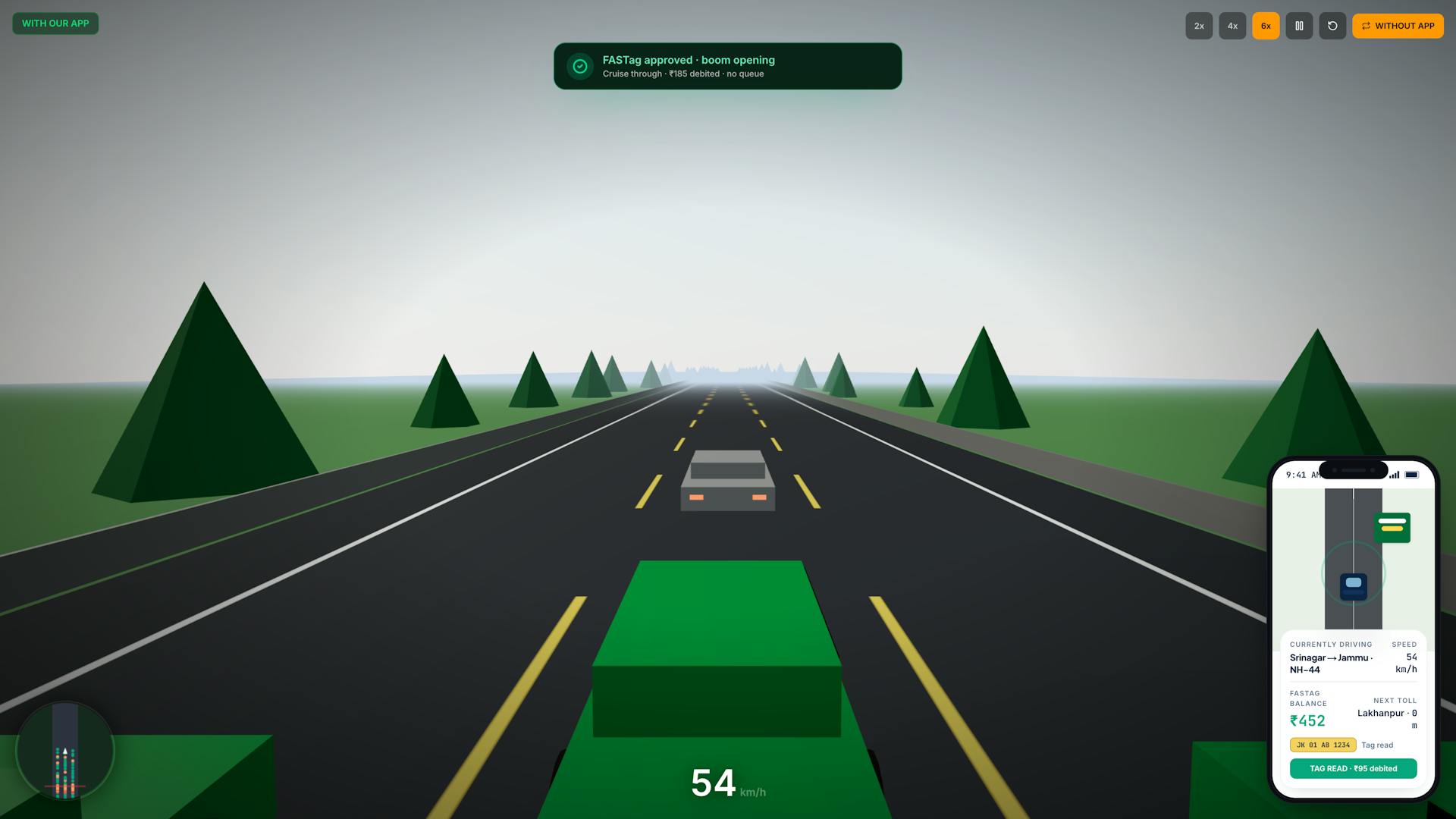
We built a 3D simulator (Next.js 16 + React Three Fiber) that runs the Nagel–Schreckenberg cellular automaton — the
canonical 1992 traffic-flow model to show the jam forming in real time, side-by-side: "Without our app" vs "With our
app." 80 instanced background cars, custom queue-car geometry, and a real traffic-jam audio loop that unlocks on
first interaction.
Stack: Next.js 16, React Three Fiber, Three.js, Tailwind, Vercel.
AI disclosure: Built with Claude (Anthropic) as a pair-programming collaborator used for scaffolding the Three.js
scene, tuning the cellular-automaton parameters against real highway data, and iterating on the landing-page copy.
Live: chainbreaker.sh
What tools did you use to create your project?
How much experience does your group have? Does the project use anything (art, music, starter kits) you didn't create?
we created it using (Next.js, React, TypeScript) but this was my first time using React
Three Fiber and Three.js picked them up during the hackathon.
Three Fiber and Three.js picked them up during the hackathon.
What challenges did you encounter?
we faced a lot of issues because of the 3d demo, as it was not working for us and we used claude cli so that our times will be saved and not invested in the things which are easy to do with ai.


Made with 💖 by robots running our open-source software and GraphQL APIs.